
NFA Changes 2026: An FFL Dealer’s Counter Checklist
A customer walks into your shop and asks, “Can I take this suppressor home today?” The NFA changes in 2026 give FFL dealers a reason to review the entire handoff—from the first quote to the final record.
For an FFL owner, the question is bigger than whether a tax or approval step changed. What should your employee check? Who decides which transfer path applies? Where does that decision live when a different staff member handles pickup?
This guide turns the October policy news into an owner’s review agenda: transfer procedures, SOT obligations, state-law questions, customer communication and recordkeeping. It also shows where connected FFL software can support the work.
The starting point was The Trace’s October 15 reporting ↗. The dealer-specific analysis below draws on ATF’s original guidance and identifies operational recommendations separately from legal requirements.
Research snapshot: October 19, 2026. Use this as a management review checklist alongside current official guidance and advice for your jurisdiction. The maps are screening tools, not transfer clearance.
01 / THE OWNER’S BRIEFING
NFA changes 2026 for FFL dealers: what to review first
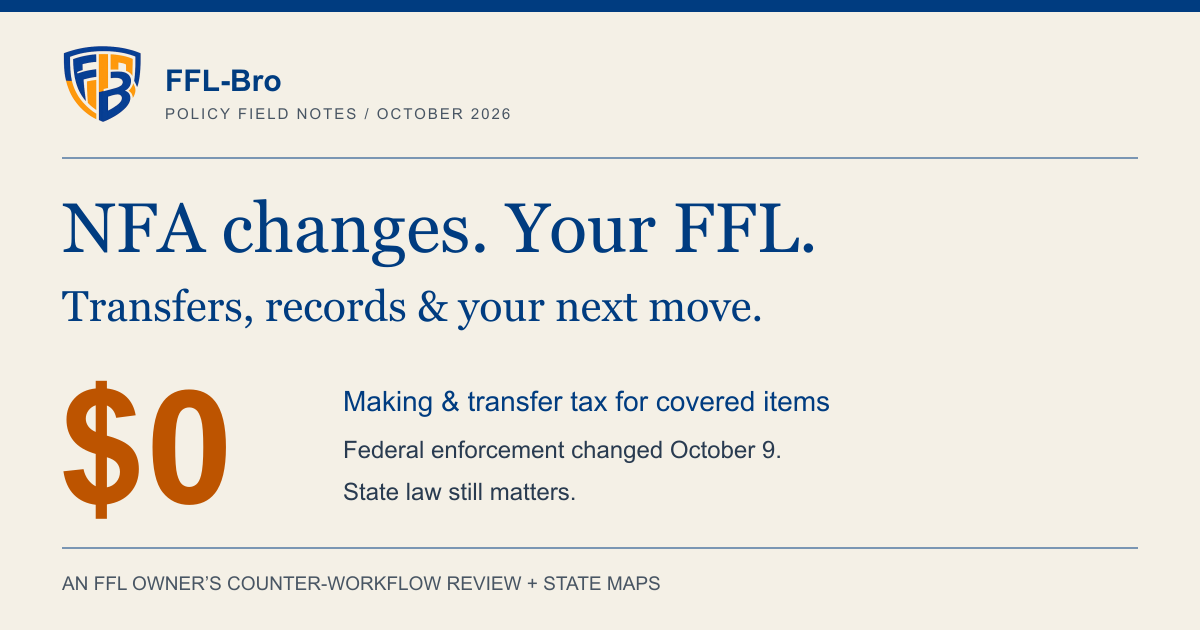
The tax change and the enforcement change are separate events. Section 70436 of Public Law 119–21 set making and transfer taxes at $0 for the covered categories, effective January 1, 2026. ATF’s October 9 policy later stopped requiring advance NFA approval and registry entries for suppressors, short-barreled rifles and shotguns, and “any other weapons.” Tax law ↗ · ATF open letter ↗
The NFA remains on the books. The Texas district court’s relief and ATF’s broader enforcement discretion have different scopes. Avoid teaching staff that the law was repealed. Court opinion ↗
Your business obligations need their own review. ATF preserves special occupational taxes for businesses handling these items, Gun Control Act recordkeeping and applicable background checks, and state and local restrictions. Full NFA requirements continue for machine guns and destructive devices. ATF’s express limits ↗
Start with four questions for your shop
- Does our licensing and SOT status cover the business activity?
- Which federal and state rules apply to this item and transaction?
- Who approves exceptions or unresolved state-law questions?
- Can we retrieve the item, customer, transaction and supporting records together?
These are suggested management checks, not an exhaustive statement of legal requirements.
Law enacted
Congress changes making and transfer tax rates.
$0 takes effect
Zero-tax treatment begins for covered categories.
Court opinion
Texas district court orders relief for specified parties.
ATF policy
Agency announces broader nonenforcement.
Sources: Public Law 119–21 ↗ · Court opinion ↗ · ATF letter ↗
Update the suppressor-transfer workflow your staff actually uses.
Consider a routine handoff: one employee quotes the item, another receives it, and a third completes the customer pickup. If each person relies on a different note or remembers a different rule, the process depends too heavily on memory.
Our recommendation is to write one dated procedure, assign an owner to it, and test it against a sample transaction. Build the procedure around these decision points:
| Decision point | What the owner should establish |
|---|---|
| Item and transaction | How staff identify the device category and the transfer being requested. |
| License and SOT | Who verifies the business’s status and handles questions before staff quote a completion date. |
| State-law review | Where current jurisdiction-specific instructions are kept and when a question goes to management or counsel. |
| Forms and checks | How the required Form 4473, applicable background check and supporting records stay tied to the correct item. |
| Customer handoff | Who communicates the next step, records the conversation and follows up. |
| Final review | Who resolves an incomplete step before the shop treats the transaction as finished. |
For short-barreled rifles and shotguns, ATF separately discusses its interim approach to the Gun Control Act dealer-transfer authorization provision and continued Form 20 approval for interstate transport. Keep those categories distinct from a suppressor workflow. ATF industry and transport FAQs ↗
If the review exposes repeated typing or records spread across several tools, examine the connection between your electronic bound book, digital Form 4473 workflow, inventory and customer follow-up.
Does your transfer process depend on three systems and a sticky note?
Bring one real workflow to an FFL-Bro demo: receiving an item, linking the customer and transaction, reviewing the record, and handing the next task to your staff. Ask us to show how those steps connect.
Request an FFL-Bro dealer demo ↗For licensed FFL dealers. Bring your current transfer process and the handoffs you want to improve.
02 / THE STATE-LAW LAYER
Your customer’s state belongs in the transfer review.
Use these maps to spot questions your staff should escalate. Map 1 summarizes reported general suppressor bans; Map 2 identifies a historical registration watchlist with verified Washington and Mississippi examples. Neither map approves a dealer transfer.
Where general civilian bans remain
Eight states and D.C. are reported as generally barring civilian suppressor ownership. The other 42 states have a path to ownership, subject to conditions.
Equal-size state tiles · approximate placement · includes D.C. · no geographic scale
Map 1 sources: The Trace, Oct. 15 ↗ and ASA state overview ↗. Broad civilian summary; exceptions and local rules are not mapped. This is a suppressor map, not an SBR/SBS map.
Where federal registration needs a closer look
Start with Silencer Shop’s August 13 list of 15 states. Mississippi’s October 12 AG statement and Washington’s statutory text are separately highlighted. Other states have not received a current legal audit here.
Equal-size state tiles · approximate placement · includes D.C. · no geographic scale
Map 2 baseline: Silencer Shop, Aug. 13 state list ↗. Updates: Mississippi AG, Oct. 12 ↗ and Washington statute ↗. No nationwide count of currently mandatory registration states is asserted. Download map data (CSV) ↓
How to read the maps and their limits
Both maps use equal-size state tiles so every jurisdiction can be selected, including small states. Tile positions are schematic. Map 1 encodes a reported general civilian suppressor ban, not eligibility, hunting rules, or permission to transfer. Map 2 encodes membership in a dated industry screening list. It does not turn those historical claims into current legal conclusions. Mississippi and Washington receive distinct categories because we checked primary materials. A state outside the list is not cleared for an unregistered transaction.
The historical 15-state list is Alaska, Colorado, Connecticut, Georgia, Michigan, Mississippi, Montana, Nevada, North Carolina, North Dakota, Ohio, Oregon, Pennsylvania, Washington, and Wisconsin. Map data distinguish that baseline from current verification. Baseline source ↗
| State / D.C. | General ban reported | Registration review |
|---|---|---|
| Alabama | No | Outside historical watchlist; current interpretation not verified |
| Alaska | No | Historical industry flag; current interpretation not verified |
| Arizona | No | Outside historical watchlist; current interpretation not verified |
| Arkansas | No | Outside historical watchlist; current interpretation not verified |
| California | Yes | General civilian ban reported |
| Colorado | No | Historical industry flag; current interpretation not verified |
| Connecticut | No | Historical industry flag; current interpretation not verified |
| Delaware | Yes | General civilian ban reported |
| District of Columbia | Yes | General civilian ban reported |
| Florida | No | Outside historical watchlist; current interpretation not verified |
| Georgia | No | Historical industry flag; current interpretation not verified |
| Hawaii | Yes | General civilian ban reported |
| Idaho | No | Outside historical watchlist; current interpretation not verified |
| Illinois | Yes | General civilian ban reported |
| Indiana | No | Outside historical watchlist; current interpretation not verified |
| Iowa | No | Outside historical watchlist; current interpretation not verified |
| Kansas | No | Outside historical watchlist; current interpretation not verified |
| Kentucky | No | Outside historical watchlist; current interpretation not verified |
| Louisiana | No | Outside historical watchlist; current interpretation not verified |
| Maine | No | Outside historical watchlist; current interpretation not verified |
| Maryland | No | Outside historical watchlist; current interpretation not verified |
| Massachusetts | Yes | General civilian ban reported |
| Michigan | No | Historical industry flag; current interpretation not verified |
| Minnesota | No | Outside historical watchlist; current interpretation not verified |
| Mississippi | No | AG interpretation: Form 4 voluntary |
| Missouri | No | Outside historical watchlist; current interpretation not verified |
| Montana | No | Historical industry flag; current interpretation not verified |
| Nebraska | No | Outside historical watchlist; current interpretation not verified |
| Nevada | No | Historical industry flag; current interpretation not verified |
| New Hampshire | No | Outside historical watchlist; current interpretation not verified |
| New Jersey | Yes | General civilian ban reported |
| New Mexico | No | Outside historical watchlist; current interpretation not verified |
| New York | Yes | General civilian ban reported |
| North Carolina | No | Historical industry flag; current interpretation not verified |
| North Dakota | No | Historical industry flag; current interpretation not verified |
| Ohio | No | Historical industry flag; current interpretation not verified |
| Oklahoma | No | Outside historical watchlist; current interpretation not verified |
| Oregon | No | Historical industry flag; current interpretation not verified |
| Pennsylvania | No | Historical industry flag; current interpretation not verified |
| Rhode Island | Yes | General civilian ban reported |
| South Carolina | No | Outside historical watchlist; current interpretation not verified |
| South Dakota | No | Outside historical watchlist; current interpretation not verified |
| Tennessee | No | Outside historical watchlist; current interpretation not verified |
| Texas | No | Outside historical watchlist; current interpretation not verified |
| Utah | No | Outside historical watchlist; current interpretation not verified |
| Vermont | No | Outside historical watchlist; current interpretation not verified |
| Virginia | No | Outside historical watchlist; current interpretation not verified |
| Washington | No | Verified statute: use tied to federal registration |
| West Virginia | No | Outside historical watchlist; current interpretation not verified |
| Wisconsin | No | Historical industry flag; current interpretation not verified |
| Wyoming | No | Outside historical watchlist; current interpretation not verified |
Give employees a state-law escalation path.
Mississippi and Washington illustrate why a national headline cannot become a universal counter instruction. Mississippi’s October 12 AG statement interprets Form 4 as voluntary for suppressors under that state’s law, while identifying related statutory issues. Washington’s RCW 9.41.250 explicitly ties its suppressor-use exception to federal registration and lawful possession. Mississippi AG statement ↗ · Washington statute ↗
For your operation, consider keeping the official source, review date, decision owner and unresolved question together in your internal procedure. Treat the map as a prompt to investigate, rather than a substitute for that procedure.
Review your website and sales scripts at the same time. A banner promising an immediate take-home purchase can get ahead of the review your staff still needs to complete. Set the customer’s expectation around the applicable transaction requirements.
03 / THE CONVERSATION AT THE COUNTER
Prepare a clear answer for the next suppressor customer.
“The federal policy changed, but we still need to review the requirements for this item and your transaction. We’ll explain the applicable paperwork and state-law questions before we promise a pickup date.”
This is suggested customer-service language. Have the person responsible for your shop’s procedures adapt it before staff use it.
Keep product education accurate too. A 2018 study available through CDC measured a 17–24 dB reduction in peak sound pressure at the shooter’s ear for the tested setups. The authors still recommended hearing protection. Give staff that distinction instead of a blanket “hearing-safe” sales claim. Hearing research ↗
Continued hearing protection recommended.
Murphy et al., 2018. This range is not a guarantee for every firearm, load, suppressor or setting.
04 / FROM POLICY NEWS TO SHOP MANAGEMENT
Use the review to find the gaps in your FFL software.
A useful software evaluation starts with a task your staff performs. Ask whether you can follow a serialized item from receipt into the transaction, find the associated customer record, see the next action and retrieve the supporting history without rebuilding the story by hand.
FFL-Bro’s dealer-management features include electronic A&D records, digital Form 4473 workflows, serialized inventory, CRM and transfer tracking. Its NFA-Bro feature descriptions cover forms, document collection, status milestones, SOT records and customer communication. Availability depends on the selected plan and modules.
Use those capabilities as demo questions. Have us show the workflow your shop needs, including how staff distinguish transactions using an NFA registration process from other transaction paths. Confirm current product behavior and configuration rather than assume a rule change has been automatically implemented.
Software supports the process; the licensee remains responsible for the transaction and its records. FFL-Bro is not a substitute for a current legal determination.
Bring this list to your dealer demo
- Your FFL type, SOT status and the transaction categories you handle.
- The tools you currently use for A&D, Form 4473, inventory and customer records.
- One receiving-to-pickup workflow that causes repeated entry or missed handoffs.
- The reports and record exports your owner or manager needs to review.
- The staff roles, locations and follow-up tasks you want to connect.
See FFL-Bro with your shop’s workflow in view.
You have a business to run while the rules and customer questions evolve. Request a personalized dealer demo and show us where your current tools make the handoff harder than it needs to be.
Request an FFL-Bro dealer demo ↗For licensed FFL dealers. Bring your current transfer process and the handoffs you want to improve.
Compare workflows first: explore FFL-Bro features.
FFL dealer FAQ: suppressor transfers and the 2026 NFA changes
Can a non-SOT FFL assume it can now sell suppressors?
No. ATF says the business-level special occupational taxes remain. Verify the license and SOT requirements for your activity before changing what your shop offers. ATF limits ↗
Are Form 4473 and applicable background checks still part of a dealer transfer?
Yes. ATF’s guidance retains the Gun Control Act requirements. A changed NFA approval process does not remove those dealer obligations. ATF transaction guidance ↗
Should our shop stop all NFA registration processing?
A blanket instruction misses the distinctions. ATF still accepts voluntary processing; state-law questions and unaffected NFA categories remain. Decide the applicable path for the item and transaction. ATF FAQs ↗
Can customers simply register an unregistered item later?
Do not promise that option. ATF says there is no general subsequent-registration right or automatic grandfathering. Review its future-risk discussion before advising a customer about choices. ATF future-risk guidance ↗
Can FFL-Bro decide whether a particular transfer is legal?
FFL-Bro provides dealer workflow and recordkeeping software. Your shop’s responsible personnel must establish the applicable requirements. A dealer demo is the place to evaluate the software against your approved procedures.
THE RESEARCH FILE
Sources, dates & transparency.
This is original FFL-Bro analysis prompted by The Trace’s reporting. Reporting, legal documents, scientific evidence, and editorial judgments are identified separately. All sources were accessed October 19, 2026. No claim of a complete 50-state legal review is made.
- The Trace · October 15, 2026 ↗
Jennifer Mascia and Chip Brownlee’s reporting that prompted this explainer.
- Public Law 119–21 · §70436 ↗
Enacted July 4, 2025; the making and transfer tax amendments and effective-date provision.
- Silencer Shop Foundation v. ATF · opinion ↗
Northern District of Texas, August 5, 2026; constitutional reasoning and scope of relief.
- ATF · October 9 open letter ↗
Nationwide enforcement policy and its five express limits.
- ATF · guidance and FAQs ↗
Official guidance page, updated October 16, 2026; transaction rules and future-risk discussion.
- Mississippi attorney general · October 12 ↗
Official interpretation that Form 4 for suppressors is voluntary; also identifies unresolved statutory issues.
- Washington · RCW 9.41.250 ↗
Primary statute linking suppressor use to federal registration and lawful possession.
- Murphy et al. · International Journal of Audiology ↗
2018 experimental study, available through CDC; measured noise reduction and remaining hearing risk.
- Silencer Shop · state breakdown ↗
Commercial participant in the litigation. August 13 state list used only as a historical screening baseline.
- American Suppressor Association · state legislation ↗
Advocacy organization’s state-policy overview; cross-check for the eight-state ban count.
- ASA via NASGW · September 2, 2026 ↗
Industry advocacy perspective on state laws tied to the NFA. Predates the October guidance.
- FFL-Bro product features ↗
Product source for electronic A&D, digital Form 4473, serialized inventory, CRM and NFA workflow descriptions; not a source of legal authority.
- FFL-Bro dealer demo request ↗
Verified destination for licensed dealers who want a personalized product walkthrough.